About how to calculate the current of a MOSFET when it is turned on, based on the classical pinchoff model, the channel length modulation effect, and some discussions about the inconsistencies and limitations of the model.
Charge and Velocity of Channel Carriers
MOSFET is basically a switch controlled by gate. When
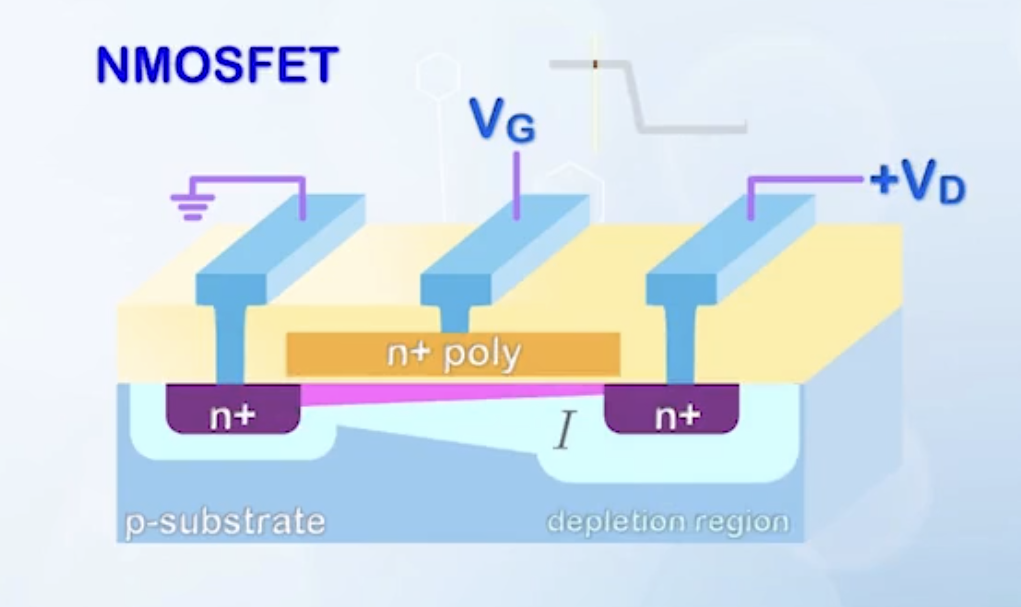
Assume source and substrate are grounded
- As a switch,
- When
- The electric field is the main driving force, and the current is mainly drift current
- The current depends on the number of charge available, and the velocity of these charges
- The current at any location
- Defining
- There is no accumulation or removal of charges, the current flows remains constant along the channel
- The region with more charges will have lower velocity, and vice versa
- Starting from a small
- For a MOSFET with channel length
- The charge per unit length is the above divided by
- For a MOSFET with channel length
- When
- The voltage in the channel somewhere between source and drain is
- The voltage in the channel somewhere between source and drain is
- The velocity of electrons are usually assumed to be proportional to the electric field
- When electrons are moving near the silicon-oxide interface, the mobility is lower due to more scattering
- For holes in silicon
- When electrons are moving near the silicon-oxide interface, the mobility is lower due to more scattering
- The current is given by
Linear Region Current Equation
The electric field is the negative gradient of voltage
Now the current equation becomes
There should be a negative sign in the equation, but let’s focus on the magnitude for now
Integrating both sides from source to drain
A simpler approach is
- The current is also given by
- The average charge per unit length is just the average of the charge at source and drain
- As of the average velocity
- If we assume the electric field is uniform along the channel
- In reality, the electric field near the source is lower, and that near the drain is higher, as electrons move faster near the drain
- However, integrating
- Therefore,
- The current is also given by
Saturation Region Current Equation
As
For the inversion charge distribution
to be valid,
This will happen at the drain when
A pinchoff region, where the channel is depleted, will form near the drain
The channel can be separated into two different regions by the
- Gradual channel region: the region where
- Pinchoff region: the region where
- Gradual channel region: the region where
All drain voltage beyond
!!!INCONSISTENCY MENTIONED!!!
In the pinchoff region, the channel is depleted, and
This inconsistency will be resolved later, and for now, we just forget about the pinchoff region, and assume the drain is moved to the
Assuming the pinchoff region is very small compared to the channel length, and the length of the gradual channel region can be approximated as
Then, the current in the pinchoff condition is calculated with the same equation as before, but with
Any
Therefore, the final current equation is
- The first region is called the linear region or triode region, and the second region is called the (current) saturation region
- The separation between the two regions is
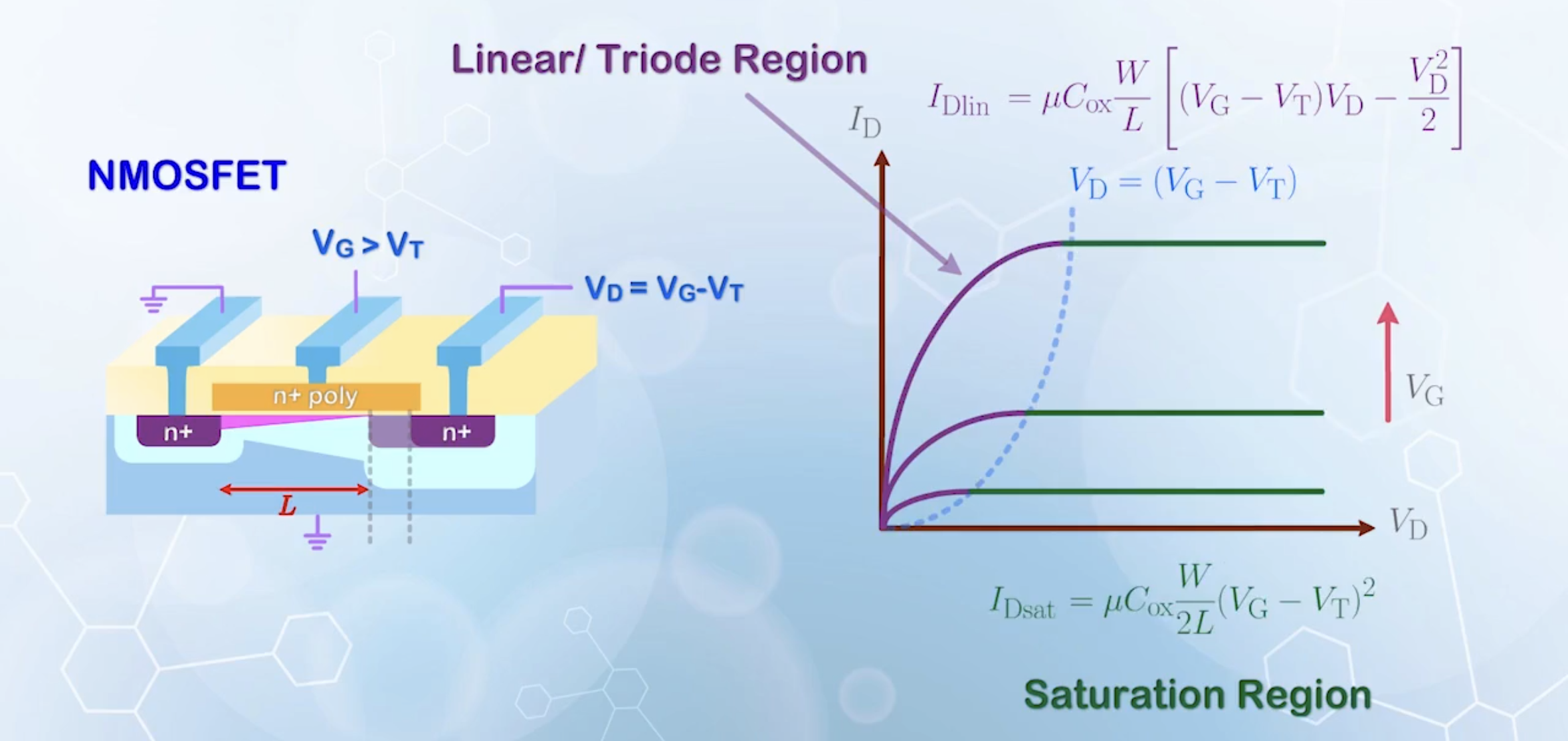
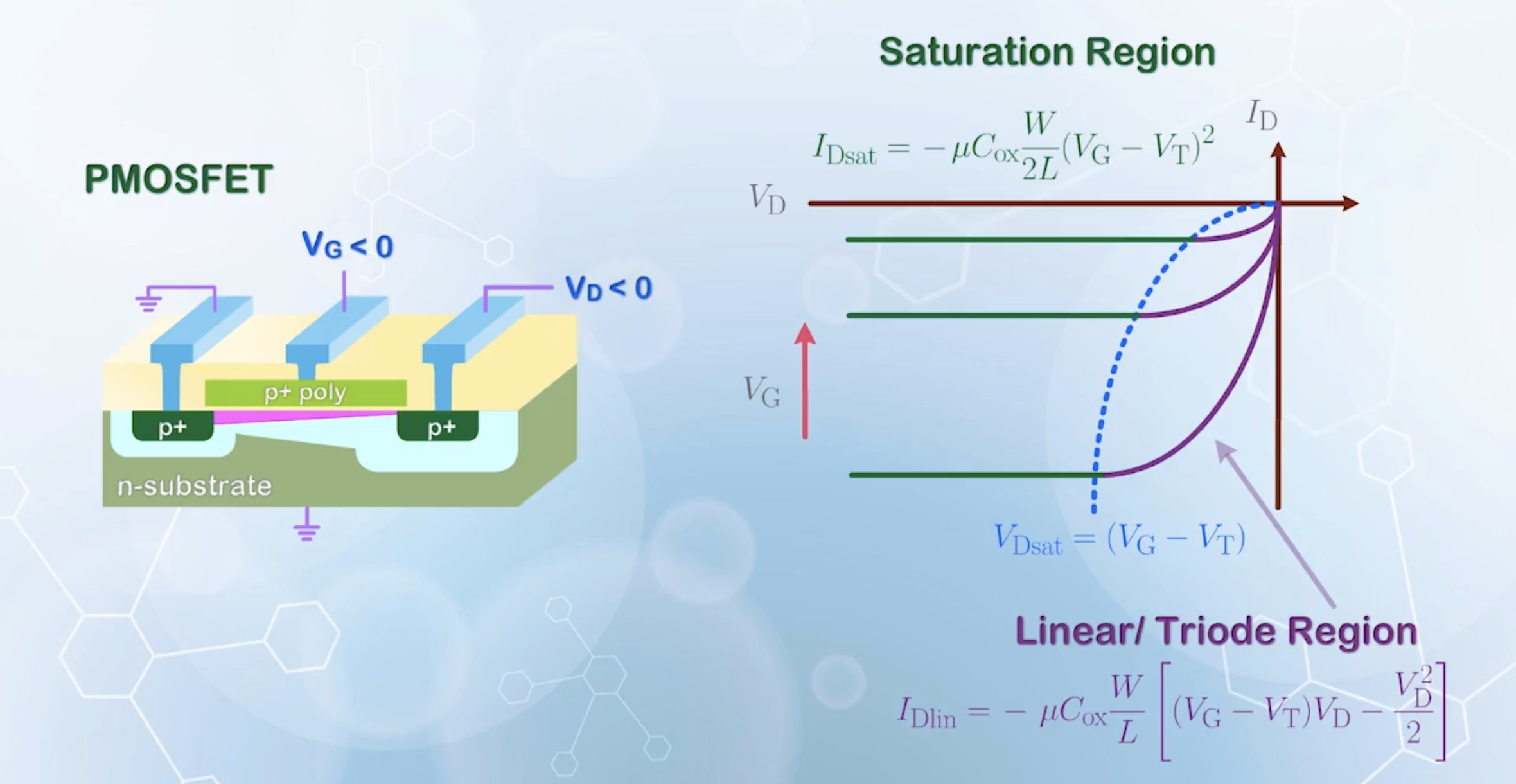
Same applies to PMOSFET, with voltages and currents become negative relative to the source
- Negative sign is added to the current, as the current in PMOSFET flows out of the drain
Channel Length Modulation
Previously, we assumed the drain voltage beyond
- In saturation region, the current is given by
- Replacing
- To calculate
- In the pinchoff region, there are only the depleted charge from the dopant ions
- Therefore, the charge density is
- Integrate twice to get the voltage difference across the pinchoff region
- The voltage across the pinchoff region is
- Thus,
- Putting it back
!!!INCONSISTENCY BACK AGAIN!!!
For the same reason mentioned before,
- As the range of
- The slope in the
- Therefore,
- Therefore,
Inconsistencies in the Pinchoff Model
We have derived different equations for the MOSFET current in linear and saturation regions based on the pinchoff model.
- For
- For
- There are some inconsistencies
- Mathematical inconsistencies: using the two equations, the current at
- Actually, the equation given for the saturation region is only used to illustrate the effect of
- The simplest way to correct for the discontinuity is just substitute
- We just assume the channel length modulation effect is very small, and use
- Actually, the equation given for the saturation region is only used to illustrate the effect of
- Physical inconsistencies: according to the pinchoff model,
- Mathematical inconsistencies: using the two equations, the current at
- However, it is still a good approximation to reality in some special cases
- These are the limitations of the pinchoff model, more accurate models will be discussed later